
Mahapada Jataka
Mahapada Jataka
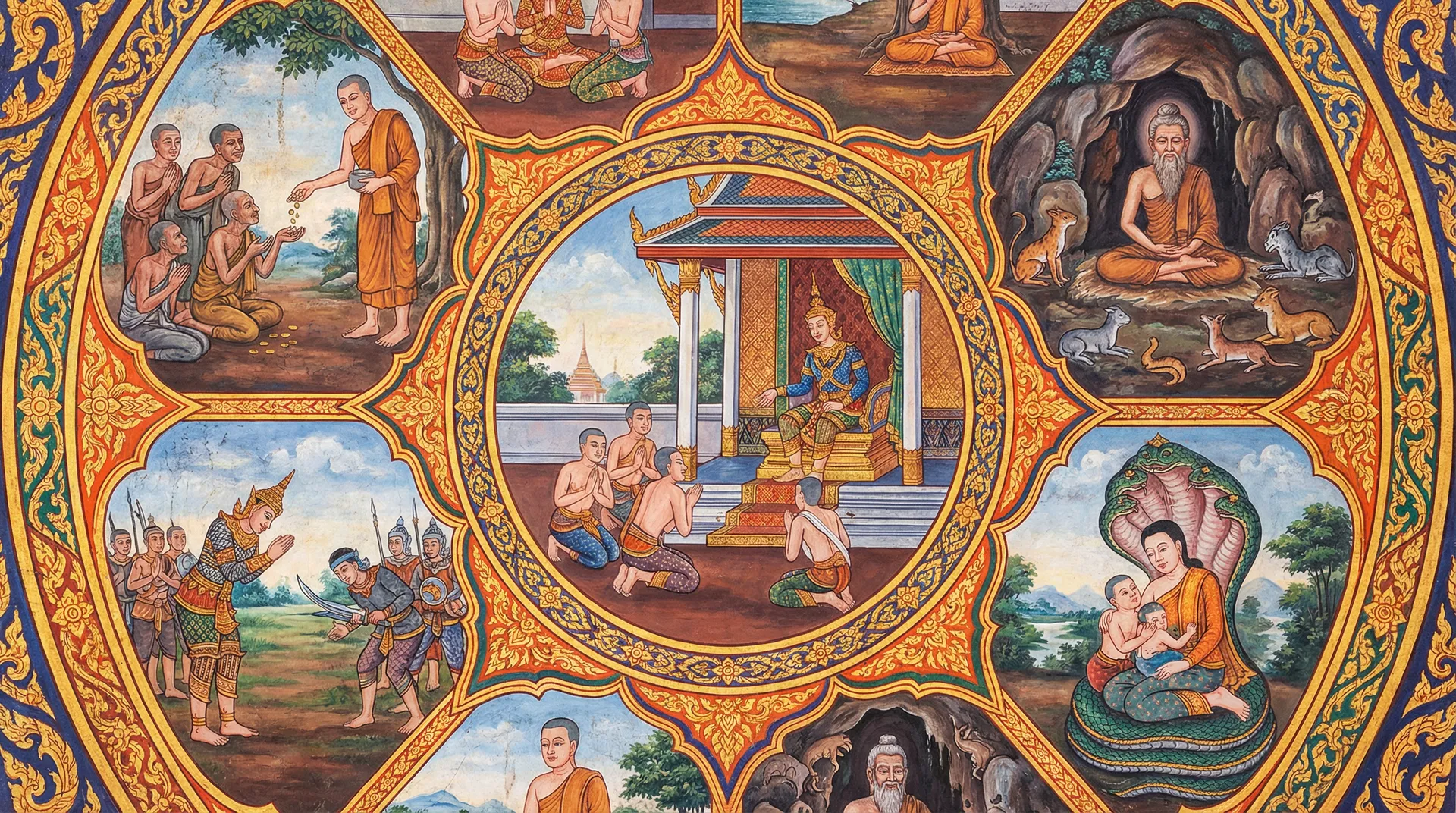
In the ancient and prosperous city of Varanasi, there reigned a king named Bodhisatta, whose heart was as vast as the ocean and whose wisdom illuminated his kingdom like the sun. He was a king who embodied the highest virtues, ruling with justice, compassion, and an unwavering commitment to the welfare of his subjects. His reign was a golden age, a testament to the power of virtuous leadership.
One day, a profound question arose in the minds of the king's wisest advisors and scholars: What is the greatest good that a king can bestow upon his people?
The scholars debated, offering various perspectives. Some argued for material prosperity, for abundant harvests and thriving trade. Others emphasized military strength, the security that a powerful army could provide against external threats. Still others spoke of upholding the law, ensuring justice and order.
King Bodhisatta listened patiently to their arguments, his brow furrowed in deep thought. While he acknowledged the importance of these aspects of governance, he felt that there was something even more fundamental, something that transcended the temporal and the material.
He summoned his court to the grand assembly hall, where the air was thick with anticipation. "My esteemed advisors and scholars," he began, his voice resonating with calm authority, "you have spoken of many good things a king can provide. However, I believe the greatest good, the most enduring gift, is not something that can be seen or touched, but something that must be cultivated from within."
He paused, allowing his words to sink in. "The greatest good a king can bestow is the teaching of the Dhamma – the path of righteousness, the way of virtue, the understanding of the interconnectedness of all beings and the consequences of their actions. For if my people understand the Dhamma, they will naturally cultivate wisdom, compassion, and ethical conduct. They will find happiness not in fleeting pleasures or external security, but in the peace and fulfillment that come from living a virtuous life."
The king then set about establishing a system to disseminate the teachings of the Dhamma throughout his kingdom. He appointed learned monks and scholars to travel to every village and town, to teach the principles of loving-kindness, non-violence, truthfulness, and generosity. He himself often led discussions, explaining complex concepts with simple parables and profound insights.
He ensured that the laws of his kingdom were not merely punitive, but also aimed at guiding his subjects towards righteous behavior. Festivals were organized not for revelry alone, but to celebrate virtuous deeds and to reinforce moral values.
The impact of King Bodhisatta's teachings was transformative. The people of Varanasi, guided by the Dhamma, began to live lives of greater contentment and ethical awareness. Greed diminished, replaced by generosity. Anger subsided, replaced by compassion. Deceit gave way to honesty.
The kingdom flourished, not just in material wealth, but in the depth of its spiritual well-being. The people were not merely prosperous; they were also at peace. They understood that true happiness was an internal state, cultivated through virtuous living and a clear understanding of the nature of reality.
When King Bodhisatta's reign eventually came to an end, his legacy was not one of grand monuments or conquered territories, but of a kingdom transformed by the power of wisdom and compassion. His teachings had sown seeds that continued to bear fruit for generations, ensuring that his people would always have access to the path of liberation.
The scholars of his court, who had once debated the nature of a king's greatest gift, now understood. They realized that while material well-being and security were important, the ultimate gift, the true foundation of a lasting and meaningful existence for his people, was the profound and liberating wisdom of the Dhamma, imparted by their virtuous king.
— In-Article Ad —
💡Moral of the Story
The greatest gift a ruler can give to their people is the teaching of righteousness and virtue (Dhamma), which leads to inner peace, wisdom, and lasting happiness.
Perfection: Wisdom (Prajna) / Righteousness (Dhamma)
— Ad Space (728x90) —
More Jataka Tales You May Enjoy
 171Dukanipāta
Mahīsosaka Jātaka
Mahīsosaka JātakaIn the ancient kingdom of Mithila, nestled amongst rolling hills and verdant forest...
💡 True loyalty and affection cannot be bought or coerced. The worth of a creature, or a person, is not determined by external forces but by their inner spirit and their bonds with those who truly care for them.
 357Pañcakanipāta
Sattubhatta Jataka
Sattubhatta Jataka Long ago, in a time when gods and humans walked more closely, the great Bodhisatt...
💡 True wealth is not measured by possessions, but by generosity and the well-being of others. Greed leads to emptiness, while sharing brings true satisfaction and prosperity.
 311Catukkanipāta
Nimi Jataka
Nimi JatakaLong ago, in the heart of the magnificent city of Mithila, ruled a just and benevolent ki...
💡 The path to true happiness and spiritual elevation is paved by one's own virtuous actions, guided by wisdom and compassion.
327CatukkanipātaThe Monkey King Jataka
The Monkey King Jataka In the verdant expanse of the Himalayan foothills, where ancient trees whispe...
💡 True leadership lies in selfless sacrifice for the well-being and survival of one's followers, embodying compassion and unwavering commitment.
 398Sattakanipāta
Mugapakkha Jataka
Mugapakkha JatakaIn the ancient land of Magadha, where rivers flowed like veins of life through fert...
💡 Genuine forgiveness and the complete release of past resentment, demonstrated through consistent acts of goodwill and compassion, can overcome karmic obstacles and bring about profound inner peace.
 289Tikanipāta
The Serpent King's Generosity (Phala Jātaka)
The Serpent King's Generosity (Phala Jātaka) In a realm where the boundary between the mortal world ...
💡 True wealth lies in selfless generosity and the willingness to share one's blessings, for compassion nourishes not only others but also the giver and the world around them.
— Multiplex Ad —